

Hyaluronic Acid: Your Face Already Loves It. Your Softest Skin Can Too
There is a small bottle on many women’s bathroom shelves that nobody can pronounce correctly the first time. Hi-uh-lure-on-ick. It costs anywhere from under ten dollars to a few hundred, depending on the label. It is one of the best-known ingredients in modern skincare for a reason: it works.
It just doesn’t only belong on faces.
What hyaluronic acid actually is
Hyaluronic acid — HA, mercifully — is a molecule your body already makes. It lives in your skin, your joints, your eyes, and, the part nobody puts on the box, just about everywhere else. Its job is simple and a little theatrical: it binds water. It is remarkably good at it.
That is the whole trick. It is why hyaluronic acid turns up in your serum, your sheet mask and your eye cream, and why hydrating is printed on so many of the bottles. It is a molecule doing what it does best, which is mostly water management dressed up in chemistry.
Same logic, different skin
If you have ever paid forty dollars for a hydrating serum, you already understand, intuitively, why it works. There is nothing magic about it. It draws water toward itself and holds it where you need it.
Mostly water managementdressed up in chemistry
The skin on your face leads a public life. It is exposed, durable, and forgiving. It is built to take weather, and it gets more care than any other skin you have.
Your most intimate skin lives a different life. It never sees the weather, it never gets a serum, and it is usually the last place anyone thinks to moisturize. Which means the same molecule you have been buying for years has somewhere else to be — somewhere your skincare routine has never reached.
This is the part of the story nobody is selling well, because the women it matters to most aren’t usually the ones reading ingredient labels.
Why women find out late
Many women first think about intimate moisture at one of two moments: after a baby, or in perimenopause. Both have one thing in common — a body in the middle of a big change, and very little time left over to notice it.
The standard answer for decades has been something for the moment. It does its one job, and it is not what anyone would call elegant. You already know hyaluronic acid from skincare. It is a humectant: its whole character is holding water.
This is why we put it in a suppository. It is a hormone-free cosmetic moisturizer, for any time of day. Inside is the same ingredient that lives in your face cream — five milligrams of hyaluronic acid, paired with squalene, vitamin E, cocoa butter, and coconut oil — this time for the most intimate skin you have.
Not only for faces
Hyaluronic acid is in cleansers, toners, lip balms and hand creams, each one made for its own stretch of skin. Nobody finds it strange that your face cream and your hand cream come in different jars.
This is the same logic every good skincare routine keeps returning to: put the ingredient where you want it. A serum puts HA on the skin of your face. A suppository puts it somewhere more private. Same molecule, same chemistry, different address.
The wellness industry has spent years training women to think about HA as a face ingredient. That was always too narrow. It is a skin ingredient. The face just happens to be the most visible skin, so it gets all the marketing.
The grown-woman point
If you are forty-three and you have been buying serums for fifteen years, you already trust the science. You are not asking what is it. You are asking why didn’t anyone tell me sooner.
That is, in many ways, the whole conversation around women’s intimate comfort right now. The information has been there. The ingredients have been there. The subject has, quietly, been left off the table for a long time — because women were taught it didn’t count.
It counts. It deserves the same care as your face. And that care has a name you already know: the molecule sitting on your bathroom shelf.
The same logic. The same care. A different address.
Wellness isn’t earned · It’s lived
Turn the page Vitamin E: The Quiet Second Ingredient
A slow paper about living well
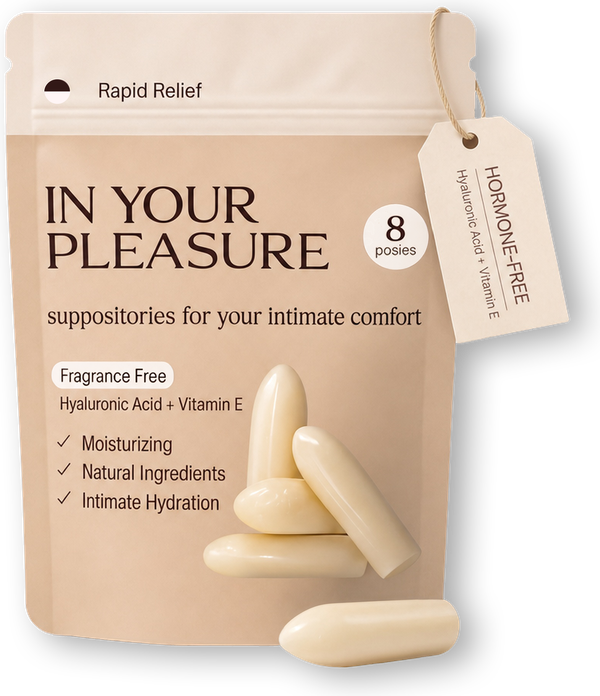
- Five ingredientsHyaluronic acid and vitamin E
- Mess-freeMelts inside with nothing to rinse
- Hormone-freeAnd fragrance-free