

The Mediterranean Already Solved Intermittent Fasting
There’s a riddle nobody can quite explain about how the Mediterranean eats.
The bread. The pasta. The wine. The olive oil by the cup. The cured meats and the soft cheeses and the fried calamari and the gelato after dinner and the espresso after the gelato. By every rule the American wellness industry has issued in the last forty years, this should produce the unhealthiest stretch of population in the developed world. Instead, Italians, Spaniards, and Greeks consistently rank among the longest-lived, lowest-cardiovascular-risk populations on earth — and the women of those cultures are still wearing, at fifty-five, the linen they bought at thirty-five.
The real explanation is structural. Mediterranean cultures eat — and don’t eat — on a rhythm that the American wellness industry would, if forced to give it a name, call intermittent fasting.
It just doesn’t have a name in Naples or Madrid or Athens. It’s just dinner.
A Mediterranean day
Here, more or less, is the rhythm of an ordinary woman in Rome, or Madrid, or a village outside Heraklion, on a Tuesday.
- Espresso · 7 or 8 a.m. Maybe a cornetto, a small piece of bread with jam, a piece of fruit. Often nothing. The American breakfast — eggs, oatmeal, smoothie, protein bar at 6 a.m. — does not exist anywhere on the Mediterranean.
- Pranzo / almuerzo / mesimeriano · 1 to 2 p.m. The real meal. In Italy, often two courses — pasta, then meat or fish, then fruit. In Spain, the menú del día. In Greece, grilled fish or lamb with salad, bread, olive oil. Wine often. An hour, ideally two. We’ve made the case for this elsewhere.
- Merenda / merienda · 5 p.m., maybe. A piece of fruit. A small cookie. An espresso. Often nothing.
- Cena · 8 to 10 p.m., later in Spain. Lighter than lunch. Soup, an omelet, salad, cheese, fruit. Aperitivo in Milan; tapas in Seville; mezze in Athens — small, slow, social. Rarely heavy.
It just doesn’t have a namein Naples or Madrid or Athens
What you don’t see anywhere on this timeline: snacks. Smoothies between meetings. Almonds in a jar on the desk. Protein at 3 p.m. to “stabilize blood sugar.” A second breakfast.
What you do see: roughly fourteen hours, every day, with no food in the body.
That’s a 14:10 fast. By accident. For two thousand years.
Why this works for women specifically
Most of the popular intermittent fasting protocols — the ones designed by men, marketed to men, tested on men — push for sixteen, eighteen, twenty-hour fasting windows. There is a growing body of research suggesting that for women, especially perimenopausal women, those longer windows can disrupt cortisol, thyroid function, and reproductive hormones in ways men don’t experience. The female endocrine system reads a long fast as a famine signal, and starts protecting accordingly.
The Mediterranean version — call it 14:10, call it Tuesday — happens to land at roughly the longest fasting window most women’s bodies tolerate without protest. Long enough to give the digestive system real rest and keep insulin sensitivity sharp. Short enough not to spike the stress response. Gentle enough to do for life, not as a six-week protocol with a start date and an end date.
The quietest wellness hack in the world is dinner at nine, espresso at eleven. No app required.
The American mistake
The temptation, when you read this, is to turn it into a protocol. Set a fasting timer. Track the window. Buy a glucose monitor. Tell people you’re doing it. Do it Monday through Friday and “have a normal weekend.”
That instinct is exactly the wrong one. The reason the Mediterranean version works is because it is unceremonial. There is no eating identity attached to it. You are not Doing Intermittent Fasting. You are not, on Sunday brunch, “having a cheat day.” You are a woman who had cena at nine and wasn’t hungry until pranzo.
The protocol-ization of every wellness practice — the reason American IF-ers eventually fall off — is what makes it unsustainable. The thing they’re chasing is rhythm. The thing they’re imposing is structure. Those are different shapes.
The same logic applies to what you put in
The reason this rhythm works isn’t that less food is better food. It’s that Mediterranean cultures aren’t using volume to compensate for what the body never properly absorbs. They eat real food, in real meals, at real intervals — and the body uses what it gets.
The same principle applies to almost everything you take into your body. Most of what you swallow doesn’t reach the tissue that needs it; we’ve written about this — the bioavailability of oral supplements hovers somewhere between twenty-five and fifty percent for most compounds. The rest is metabolized, processed, and excreted before it ever gets to the place it was meant to go.
In Your Pleasure was built on the same logic that runs through every eating culture older than the iPhone. Less of the right thing. Delivered where it can actually be used. A small, intelligent dose. In the place that uses it.
You don’t need a bigger morning routine. You need a quieter one.
Espresso. The walk. Lunch when you’re hungry. Dinner before midnight.
That’s the protocol.
Wellness isn’t earned · It’s lived
Turn the page Hyaluronic Acid: Your Face Already Loves It. Your Tissue Wants It Too
A slow paper about living well
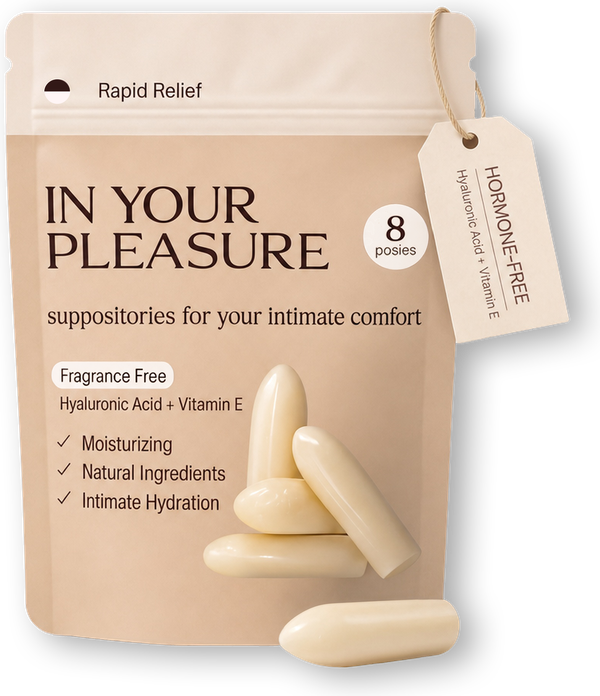
- Five ingredientsHyaluronic acid and vitamin E
- Mess-freeMelts inside with nothing to rinse
- Hormone-freeAnd fragrance-free